Hallo,
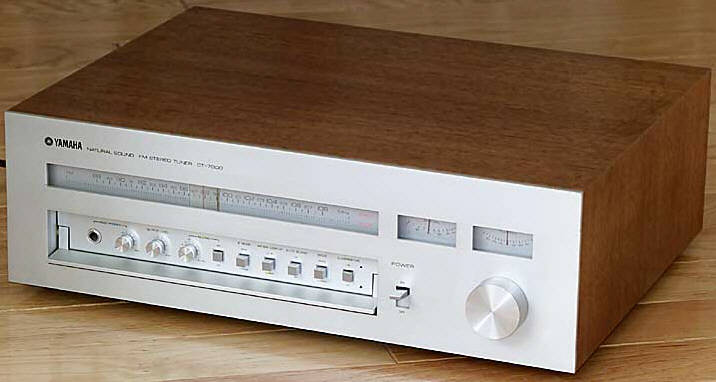
ich möchte hier kurz meinen Yamaha CT 7000 B vorstellen.
Ein paar Bilder:
http://www.fmtunerinfo.com/CT-7000.jpg (A-Version)
http://www.fmtunerinfo.com/CT-7000a.jpg (A-Version)
http://www.fmtunerinfo.com/CT-7000b.jpg
http://www.fmtunerinfo.com/CT-7000sch1.jpg
http://www.fmtunerinfo.com/CT-7000sch2.jpg
http://cgi.ebay.com/YAMAHA-CT-7000-VINT ... dZViewItem
CT-7000 Tuner; Bj.: 1974-1977; Preis: 1200.00 Dollar
CT-7000B Tuner; Bj.: 1976-1977; Preis: 1250.00 Dollar
Hier nun ein paar kleine Umschreibungen:
I'll state it flat-out: the Yamaha CT-7000 extracts the best sound
from an FM signal that I've yet heard. But I must say that I've not yet auditioned
the big ol' Day Sequerra's (hard to find in good condition), or the top Dynalab
tube model, both of which probably would give a good accounting of themselves.
But for anything near "sane" prices, the CT-7000 is IT. This tuner is packed with
useable features, is ergonomically well-thought-out, and has amazing reception
abilities. And again - the sound with any station it can pull in - weak or strong - is
excellent.
If you find one in "good" or better condition, I suggest you jump on it
immediately. When it was a current model back in the late 1970's, it retailed for
$1200., so anything less than that amount today I would consider to be a steal
for a functional unit. I'm sure you can double that retail figure for a current model
today, and not have equal or better performance than the CT-7000 will give you.
Just make sure that it's in alignment and up-to-spec, as you would any "vintage"
gear.
This is my "last" FM tuner, at least until it dies and can't be repaired anymore.
A beautiful, solidly built (29 pounds) analog tuner with the best sound our panelist Eric recalls ever hearing in his system, surpassing (among others) the top Kenwoods and Sansuis. The CT-7000 is particularly impressive at the low end. It is a pure audiophile tuner in stock form, with poor adjacent channel selectivity even in the Narrow IF mode. Our contributor David “A” reports: “The CT-7000 has a 7-gang tuning capacitor (two gangs in front of the first MOSFET RF amp, two in front of the second MOSFET RF amp, two in front of the MOSFET mixer and one for the bipolar local oscillator). It uses 7 IF filters, a mix of ceramic and LC types. The IF would be relatively easy to modify for increased selectivity, but I would wonder why anyone would want to since the CT-7000 is oriented toward sound quality and the IF choices were made in that vein. Further, one of the major reasons for the sound is the characteristics of the wide IF (the only 18 dB alternate channel selectivity makes this perhaps the widest Wide mode ever in a quality tuner). The CT-7000 uses a discrete MPX decoder. The tuner design seeks fidelity (and to a lesser degree RF performance) but in my opinion, after owning most of the top tuners, it's not in the top 5 for RF or audio quality. The quieting curve is very steep (although not as steep as the Kenwood 600T and 650T or Pioneer TX-9100), but the absolute signal-to-noise ratio plus distortion is well behind the best. I also find that the stereo separation and distortion are very good (especially for the age of the tuner) but again not up with the very best (high-frequency distortion and pilot leakage are more of a problem than the separation). The CT-7000 owes part of its sound quality to its flat and extended frequency response, but mostly to the ultra-wide IF and limiter choices which were made based on signal fidelity. Given the tuner's current age, a stock unit will be badly in need of replacing all of the electrolytic capacitors and a good alignment. The CT-7000 is not the best choice for DXers because of the lack of front end/overall selectivity, less than ideal RFIM characteristics and the presence of AFC. Overall, I prefer a Yamaha T-2 (with all polar and electrolytic coupling caps replaced and aligned perfectly) for sound quality (although not in the bass), or a Yamaha T-85 for DXing if one is predisposed to Yamaha tuners. What you do get with the CT-7000 is perhaps the best construction quality ever offered in a consumer tuner as well as a unique aesthetic look that some people love. For the money, the top Kenwoods are much better tuners (and better buys) from an RF perspective, especially when modified. And for sound, tuners like the Accuphase T-106 eat the CT-7000 alive! [By no means a universally held view. - Editor] Also, I don't like how Yamaha implemented the AFC in the front end of the CT-7000, or the fact that it has AFC at all. I found no overall problems that are likely to make the CT-7000 unreliable over time, but it is a pain to replace all of the electrolytics and realign it for best performance (if you own or buy one make sure that whoever aligns it will take the time to go through it carefully for best performance).” The CT-7000's features include a headphone output jack with level control, switchable muting with an adjustable threshold, and a signal meter that doubles as a multipath meter. The rear panel has fixed and variable audio outputs and multipath outputs for an oscilloscope. Most recent CT-7000s in good condition have sold for $700-1,000 on eBay, but as low as $500 is possible in poorer shape and as high as around $1,200 is possible for a mint one. One CT-7000B sold for $516 in 12/04.
Review: Yamaha CT-7000 Tuner
I've had this tuner for a year now and it continues to amaze me. From college radio to our classical station to ultra-compressed classic rock stations, the tuner delivers a broad, deep image (two things quite important to me), with detail and tonal accuracy from lows to highs. To aid reception, I went with a $10 Terk antenna and it is more than sufficient to bring local stations in at full strength. Does it sound as good as a CD? That depends on the CD, but usually not. CD's usually trump the tuner when it comes to high frequency accuracy, something particularly noticeable if you attend to the decay of a cymbal. Also, image depth isn't as pronounced as with my Arcam Alpha 9, nor do subtle details come through, e.g. distinct voices in background vocals. But we're talking radio here, and stations do a good deal to the signal before it hits your antenna. So one can't lay all this at the foot of the tuner. Suffice it to say that the tuner is totally involving, so while I'm listening, I don't find myself wondering what X would sound like on CD. Also, I don't listen to the radio to hear what I have on CD. Instead, I listen to hear what I don't, and for that purpose, particularly with regard to classical music, it complements my system very well, standing on its own among some solid equipment. In closing, two tweak discoveries, and a question. The background quieted when I ran the tuner through my line conditioner. Also, it was responsive to different cables. I came to favor the LAT over the Kimber Hero and the Tara RSC Prime Gen 2. I'm curious whether anyone has upgraded the RCA inputs, and with what results.
Liebe Grüße,
Matthias